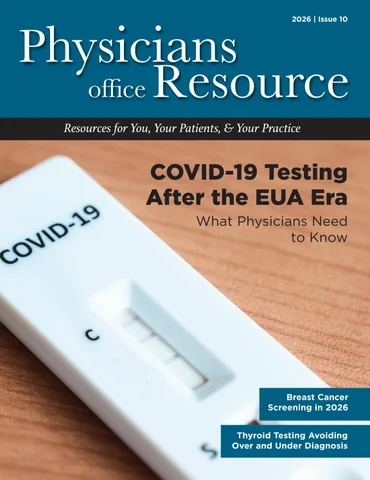
COVID-19 Testing After the EUA Era: What Physician Practices Need to Know Before December 26, 2026
Monday, October 12, 2026
For nearly seven years, Emergency Use Authorizations helped make COVID-19 diagnostic tests widely available across the United States. That regulatory chapter is now approaching its conclusion. On December 26, 2026, the federal declarations supporting Emergency Use Authorizations for SARS-CoV-2 diagnostic tests and other COVID-19 medical devices will terminate.
For physician offices, urgent care centers, laboratories, and other testing sites, the deadline requires attention—but it does not mean that COVID-19 testing is ending. Instead, it marks a transition from emergency authorization to the traditional regulatory pathways used for other diagnostic products.
Practices should begin reviewing their testing platforms, inventory, laboratory certifications, and vendor communications now. Waiting until respiratory-virus season is underway could create avoidable disruptions in testing availability and patient care.
What Is Changing?
On June 29, 2026, the Secretary of the U.S. Department of Health and Human Services determined that the circumstances justifying emergency authorization of COVID-19 medical devices no longer exist. HHS subsequently announced that three device-related
EUA declarations would terminate after a 180-day transition period, effective December 26, 2026.
The affected declarations cover:
- In vitro diagnostic tests used to detect or diagnose SARS-CoV-2
- Personal respiratory protective devices authorized during the COVID-19 outbreak
- Other medical devices, including alternative products used as medical devices because of pandemic-related shortages
When the declarations terminate, COVID-19 diagnostic products that remain authorized solely under an EUA will no longer have that federal authorization. This includes affected molecular, antigen, serology, and other in vitro diagnostic products unless the manufacturer has obtained traditional FDA marketing authorization or another applicable legal status.
The transition is broader than the withdrawal of a few individual products. It ends the underlying declaration that allowed FDA to issue and maintain device EUAs for COVID-19.
The deadline for drugs and biological products is different. The EUA declaration supporting COVID-19 drugs and biological products is scheduled to terminate on June 29, 2027. The December 2026 deadline specifically applies to diagnostic tests and other medical devices.
COVID-19 Testing Is Not Ending
The most important distinction for practices is that the end of the EUA declaration is not a prohibition on COVID-19 testing.
Tests that have received traditional FDA clearance, approval, or other appropriate marketing authorization may continue to be marketed and used according to their labeling.
Manufacturers that originally entered the market through an EUA have had the opportunity to submit their products through FDA’s established premarket review pathways.
These pathways generally require a more complete regulatory submission than an EUA. Depending on the device, a manufacturer may pursue authorization through a 510(k), de novo, or premarket approval pathway. FDA’s review considers the test’s analytical and clinical performance, manufacturing controls, labeling, intended use, and other factors.
As a result, the post-EUA marketplace will likely contain fewer COVID-19 tests, but the products that remain will have completed a conventional regulatory review. Some manufacturers may successfully transition their tests before the deadline, while others may discontinue products rather than invest in the additional regulatory process.
Physician practices should not assume that a familiar test will remain available simply because it has been used successfully for several years.
EUA Status and CLIA Status Are Different
The transition may be especially important for physician-office laboratories operating under a CLIA Certificate of Waiver.
FDA authorization and CLIA categorization serve different purposes. FDA determines whether a diagnostic device may be legally marketed for its stated intended use. CLIA requirements determine where and by whom laboratory testing may be performed based on the test’s complexity.
During the pandemic, many point-of-care and over-the-counter tests were distributed under EUAs that permitted use in settings operating under a CLIA Certificate of Waiver. The termination of those EUAs means practices must confirm that their replacement products possess both the necessary FDA marketing authorization and a CLIA status appropriate for the setting in which they will be used.
A test receiving FDA clearance does not automatically mean that every version, specimen type, or intended-use setting is CLIA waived. Practices should review the current instructions for use and FDA documentation for the precise product configuration they intend to purchase.
This is particularly important for combination tests. A multiplex assay detecting SARS-CoV-2 along with influenza A, influenza B, respiratory syncytial virus, or other pathogens may have a different regulatory status from a manufacturer’s COVID-only product. One product in a vendor’s portfolio may be traditionally authorized while another remains available solely under an EUA.
What Happens to Existing Inventory?
Practices should not assume they may continue using EUA-only tests after December 26 merely because the products were purchased before the deadline or have not reached their printed expiration dates.
An expiration date describes the period during which the manufacturer supports the product’s stability and performance. It does not independently authorize the test’s continued use after the legal authority supporting its distribution and use has ended.
FDA or HHS may issue additional product-specific transition, disposition, or enforcement guidance before the deadline. Until that information is available, practices should avoid building excess inventory of any test that relies solely on an EUA.
Manufacturers and distributors should be asked to provide written confirmation regarding:
- The product’s current FDA status
- Whether it remains authorized solely under an EUA
- Whether a traditional marketing submission has been filed
- Whether FDA has granted clearance or approval
- The product’s CLIA complexity classification
- Instructions for unused inventory remaining after December 26
- Availability of a traditionally authorized replacement
Verbal assurances from a sales representative should not substitute for current regulatory documentation.
Preparing the Physician Office Laboratory
A structured inventory review is the best place to begin. Practices should document the manufacturer, exact product name, catalog number, lot number, expiration date, specimen type, and current regulatory status of every COVID-19 test in use or storage.
The practice should then verify each product directly through FDA resources and manufacturer documentation. Similar product names can create confusion, particularly when a manufacturer markets multiple versions of an assay for laboratory, point-of-care, or home use.
Medical directors and laboratory leaders should also evaluate how a product change may affect the clinical workflow. Questions may include whether a replacement test uses the same specimen type, whether collection procedures differ, how long results take, and whether new instrumentation or quality-control materials will be required.
Additional considerations include:
- Updating standard operating procedures
- Training and documenting the competency of testing personnel
- Revising quality-control and quality-assurance processes
- Updating electronic health record order and result codes
- Confirming billing and payer requirements
- Revising patient instructions and educational materials
- Planning for confirmation or reflex testing when appropriate
- Coordinating changes with affiliated laboratories and distributors
Practices should preserve the authorization documents and instructions for use that applied while an EUA product was being used. These records may remain important for laboratory compliance, quality investigations, and interpretation of historical patient results.
Clinical Testing Still Matters
The end of emergency authorization should not be interpreted as evidence that SARS-CoV-2 has disappeared or that diagnostic testing no longer has clinical value. COVID-19 continues to circulate, and its symptoms overlap substantially with influenza, RSV, and other respiratory infections.
Testing can still influence antiviral treatment decisions, infection-control recommendations, counseling for high-risk household contacts, evaluation of vulnerable patients, and decisions about additional testing. Its value is greatest when the result is likely to change management and when the test is selected and interpreted in the context of symptom duration, specimen quality, pretest probability, and local disease activity.
Rapid antigen tests may offer speed and convenience, but a negative result does not always exclude infection, particularly early in the course of illness. Molecular assays generally provide greater analytical sensitivity, although their availability, turnaround time, and cost may differ. The regulatory transition does not change these fundamental principles of diagnostic stewardship.
Moving From Emergency Access to Routine Regulation
The December 26 deadline represents the maturation of the COVID-19 diagnostic market. Emergency authorization allowed tests to reach patients quickly when approved or cleared alternatives were limited and the public-health need was extraordinary. Traditional authorization is intended to provide a more durable regulatory foundation for continued use.
For physician practices, the transition should be treated as an operational deadline rather than a reason for alarm. The essential questions are straightforward: Which tests does the practice currently use? Which remain dependent on an EUA? Which have obtained traditional authorization? Are they appropriate for the practice’s CLIA certificate and intended testing environment?
Practices that answer those questions early will be positioned to maintain access to reliable COVID-19 testing without interrupting patient care. Those that wait until late December may face depleted inventory, limited replacement options, rushed staff training, and confusion about which products may legally be used.
December 26, 2026, will not end COVID-19 testing. It will end the emergency regulatory framework that shaped the testing market during the pandemic—and move COVID-19 diagnostics into a more conventional, permanent phase of laboratory medicine.