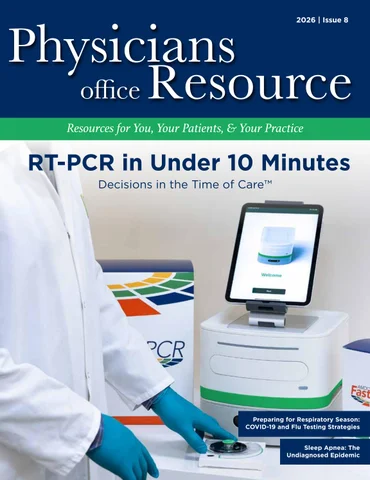
Preparing for Respiratory Season: COVID-19 and Flu Testing Strategies for Physician Offices
Monday, August 10, 2026
by Ryan Simeone, SEKISUI Diagnostics
Respiratory season always brings a familiar challenge to physician offices. Patients with COVID-19 and influenza can present with very similar symptoms, and both viruses may circulate at the same time. For clinicians and staff, that overlap can make testing decisions more important during already busy months.
For physician offices, the goal is not to make every respiratory visit more complicated. It is to choose testing options that fit the realities of outpatient care. Fast results, clear answers, efficient workflows, and confidence in the result all matter. A practical COVID-19 and flu testing approach can help support clinical decision-making while keeping patient flow manageable. While there is no one-size-fits-all approach, starting the conversation early can help practices plan for a busy respiratory season.
Why COVID-19 and Flu Still Belong in the Same Conversation
COVID-19 and influenza remain clinically important because they can look alike at the point of care. Fever, cough, sore throat, fatigue, headache, and chills may occur with either illness. CDC guidance notes that both COVID-19 and influenza can cause acute respiratory illness with overlapping symptoms, which can make treatment decisions more difficult when both viruses are suspected.1
Testing is not the only factor in care decisions. Patient history, exposure risk, risk factors, local respiratory activity, and clinical judgment all matter. Still, testing can help inform treatment decisions, patient counseling, follow-up, and precautions.1,2 That can be especially important when patients are at higher risk for complications or may be within a window for antiviral treatment.
For many offices, planning for COVID-19 and flu together makes more sense than treating them as separate seasonal issues. A single patient visit may require consideration of both viruses. A single test result may influence counseling, treatment discussions, work or school guidance, and follow-up. When the testing approach is clear, the visit can move more smoothly for both the patient and the care team.
The Role of Multiplex Testing
Multiplex testing reflects the way respiratory illness often presents in real life. A patient does not usually arrive with symptoms that clearly point to one virus over another. When COVID-19 and flu are both circulating, a test that can detect and differentiate more than one pathogen may give clinicians useful information from a single encounter.
CDC describes multiplex tests as assays that can detect and distinguish among multiple viruses from respiratory specimens, including influenza viruses, SARS-CoV-2, and RSV depending on the test.2 CDC also notes that multiplex testing can help inform antiviral treatment decisions, other clinical management decisions, and preventive measures.2
In a physician office setting, that value is both clinical and operational. Differentiating SARS-CoV-2 from influenza A or B may support more targeted patient counseling and management. A single sample and one testing pathway may also reduce extra steps for staff during high-volume periods. That can matter when offices are balancing scheduled appointments, walk-ins, phone calls, portal messages, and patient questions about whether more testing is needed.
Multiplex testing is not about testing for everything in every patient. It is about using the right level of information when the result may affect what happens next. For COVID-19 and flu, that can be relevant when symptoms overlap, treatment timing matters, or a patient needs a clearer answer before returning to work, school, or routine activities.
Rapid Antigen and Molecular Testing Each Have a Place
A strong respiratory testing strategy does not have to choose between antigen and molecular testing. Both can play an important role.
Rapid antigen testing is often valued for speed and simplicity. It can fit well into physician office workflows when a quick result is needed during the visit. It can also support same-day counseling and help staff move patients through the testing process efficiently.
Because antigen tests may have lower sensitivity than molecular tests, negative results should be interpreted in the context of symptoms, exposure history, local activity, and current product instructions.
Molecular testing offers a different value. Molecular tests generally provide higher sensitivity than antigen tests and may be preferred when greater diagnostic confidence is needed.2,3 CDC outpatient guidance states that molecular assays are preferred for patients at risk for severe disease, although antigen assays may be used if nucleic acid detection is not available.1 CDC also notes that rapid molecular assays for influenza can detect viral RNA with high sensitivity and specificity, often within a timeframe that supports clinical decision-making during the visit.3
The practical takeaway is that antigen and molecular testing do not need to compete for the same role. Antigen testing may help offices deliver fast, accessible results. Molecular testing may help when the result carries more clinical weight. Together, these options can give physician offices flexibility during a season when patient needs and visit types can vary widely.
Product Selection: How OSOM® and Metrix® Can Fit Into Respiratory Season
Product selection should support the way physician offices actually work. Respiratory season can bring higher patient volume, tighter schedules, and more pressure on front-office and clinical staff. Testing options need to be practical, easy to integrate, and aligned with the level of confidence needed for different patient encounters.
The OSOM® Flu SARS-CoV-2 Combo Test can help offices address two common seasonal concerns in one testing approach. For offices looking for a rapid point-of-care option, this combo test may help support efficient patient flow and timely counseling when a patient’s symptoms could suggest either COVID-19 or flu.
The Metrix® COVID/Flu Test gives offices a molecular option for COVID-19 and flu testing. This can be useful when practices want molecular testing focused on the respiratory viruses most often driving seasonal testing decisions. Metrix® may be especially useful when a patient is at higher risk or when symptoms suggest COVID-19 or flu. A molecular result may help inform treatment and follow-up decisions when interpreted with clinical history and other relevant information.
Together, the OSOM® rapid antigen and the Metrix® COVID/Flu molecular give physician offices a flexible testing portfolio for a respiratory season shaped by overlapping COVID-19 and flu activity.
Conclusion
COVID-19 and flu will continue to challenge physician offices because they can look similar, circulate at the same time, and require timely decisions. A useful testing strategy does not need to be complicated. It should help clinicians answer the question in front of them while fitting into the pace of outpatient care.
Multiplex testing can support clearer answers when COVID-19 and flu are both possible. Rapid antigen testing can provide speed and simplicity. Molecular testing can offer greater confidence when the clinical situation calls for it. With OSOM® and Metrix®, physician offices can consider a practical testing approach that supports clinical decision-making and outpatient workflow.
Disclosure: The OSOM® Flu SARS-CoV-2 Combo Test and Metrix® COVID/Flu Test have not been FDA cleared or approved but have been authorized by the FDA under an Emergency Use Authorization. The OSOM® Flu SARS-CoV-2 Combo Test and Metrix® COVID/Flu Test has been authorized only for the detection of proteins from SARS-CoV-2, influenza A and influenza B, not for any other viruses or pathogens. The emergency use of this product is only authorized for the duration of the declaration that circumstances exist justifying the authorization of emergency use of in vitro diagnostics for detection and/or diagnosis of COVID-19 under Section 564(b)(1) of the Federal Food, Drug, and Cosmetic Act, 21 U.S.C. § 360bbb-3(b)(1), unless the declaration is terminated or authorization is revoked sooner.
References
- Centers for Disease Control and Prevention. Clinical guidance for outpatients with acute respiratory illness at higher risk of severe COVID-19 and/or influenza. Updated December 19, 2025. Accessed July 13, 2026. https://www.cdc.gov/flu/hcp/clinical-guidance/testing-guidance-for-outpatient.html
- Centers for Disease Control and Prevention. Multiplex tests to detect influenza, SARS-CoV-2, and RSV. Updated April 27, 2026. Accessed July 13, 2026. https://www.cdc.gov/flu/hcp/testing-methods/flu-covid19-detection.html
- Centers for Disease Control and Prevention. Information on rapid molecular assays, RT-PCR, and other molecular assays for diagnosis of influenza virus infection. Updated April 30, 2026. Accessed July 13, 2026. https://www.cdc.gov/flu/hcp/testing-methods/molecular-assays.html
- SEKISUI Diagnostics. OSOM® Flu SARS-CoV-2 Combo Test. Accessed July 13, 2026. https://sekisuidiagnostics.com/product/osom-flu-sars-cov-2-combo-test/
- SEKISUI Diagnostics. The Metrix® COVID/Flu Test. Accessed July 13, 2026. https://sekisuidiagnostics.com/product/the-metrix-covid-flu-test/