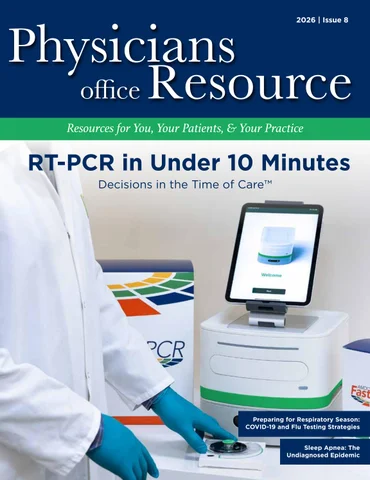
CLIA-Waived Diagnostics: How Speed and Accuracy Are Transforming Clinical Decision-Making
Wednesday, April 01, 2026
by Matt Baker, Physicians Office Resource
Introduction: The Diagnostic Imperative in Modern Primary Care
Primary care physicians today operate at the intersection of clinical complexity, patient expectations, and increasing pressure to deliver efficient, evidence-based care. Across family medicine, internal medicine, pediatrics, OB/GYN, and geriatric medicine, clinicians are tasked with making rapid decisions that directly influence outcomes, resource utilization, and patient satisfaction.
At the center of these decisions lies diagnostic testing.
Historically, primary care has relied on a combination of clinical judgment, laboratory send-out testing, and rapid in-office assays. However, delays in results, diagnostic uncertainty, and workflow inefficiencies have often complicated care delivery. The evolution of CLIA-waived diagnostics—encompassing both antigen-based and molecular testing—has begun to fundamentally change this dynamic.
Today, clinicians can access high-quality diagnostic results within minutes, enabling real-time, evidence-based decision-making. The implications are profound: faster answers, more accurate diagnoses, improved antimicrobial stewardship, and enhanced patient experiences.
Understanding CLIA-Waived Diagnostics
CLIA-waived tests are designed to be simple, safe, and reliable, allowing them to be performed in point-of-care settings without the need for complex laboratory infrastructure. These tests meet criteria established under the Clinical Laboratory Improvement Amendments (CLIA), making them widely accessible across physician offices, urgent care centers, and outpatient clinics.
Two primary categories dominate the CLIA-waived diagnostic landscape:
- Antigen-based tests, which detect specific proteins from pathogens
- Molecular tests, which detect genetic material (DNA or RNA) using amplification technologies
Each modality offers distinct advantages, and together they provide a complementary toolkit that supports a wide range of clinical scenarios.
Speed as a Catalyst for Better Clinical Decisions
Perhaps the most transformative aspect of CLIA-waived diagnostics is speed. Many tests—both antigen and molecular—deliver results in as little as a few minutes to under half an hour. This rapid turnaround reshapes the clinical encounter.
In traditional workflows, physicians often rely on empiric treatment while awaiting laboratory confirmation. This can lead to overtreatment, delayed therapy, or the need for follow-up communication once results become available. With CLIA-waived testing, clinicians can instead make immediate, data-driven decisions during the patient visit.
For example, a patient presenting with fever, cough, and malaise during respiratory virus season can be tested and diagnosed before leaving the exam room. Whether the result indicates influenza, COVID-19, RSV, or no viral infection at all, the physician can tailor treatment, counseling, and follow-up accordingly—on the spot.
This shift from delayed to real-time diagnostics improves clinical efficiency, reduces uncertainty, and enhances patient trust.
Antigen Testing: Speed, Accessibility, and Clinical Utility
Antigen-based CLIA-waived tests have long been a cornerstone of point-of-care diagnostics in primary care. Their rapid turnaround time—often within minutes—combined with ease of use and lower cost makes them highly valuable in high-volume clinical settings.
These tests are particularly effective when pathogen burden is high, such as during the early symptomatic phase of infections like influenza or COVID-19. In such scenarios, antigen testing can provide quick answers that enable immediate clinical action.
In practice, antigen tests are often used for:
- Rapid screening during peak respiratory seasons
- Triage decisions in busy clinics or urgent care settings
- Situations where immediate isolation or cohorting decisions are needed
Their speed allows clinicians to quickly identify infectious patients, initiate appropriate precautions, and begin treatment when indicated.
However, antigen tests do have limitations. Their lower sensitivity compared to molecular assays means that false negatives can occur, particularly in cases with low viral load or early infection. As a result, negative antigen results in patients with high clinical suspicion may require confirmatory testing.
Despite these limitations, antigen testing remains an essential tool—particularly when speed, cost, and accessibility are prioritized.
Molecular Diagnostics: Elevating Accuracy at the Point of Care
CLIA-waived molecular diagnostics represent a significant advancement in point-of-care testing. By detecting pathogen-specific genetic material, these tests offer superior sensitivity and specificity, bringing laboratory-level accuracy directly into the physician office.
Modern molecular platforms have been engineered for simplicity, allowing them to meet CLIA waiver requirements while delivering results in approximately 10 to 30 minutes. This combination of speed and precision makes them particularly valuable in cases where diagnostic certainty is critical.
Molecular testing is especially impactful in:
- Differentiating between pathogens with overlapping symptoms
- Detecting infections in early or low viral load stages
- Confirming negative antigen results when clinical suspicion remains high
For instance, respiratory infections caused by influenza, RSV, and SARS-CoV-2 often present similarly. Molecular assays can accurately distinguish between these pathogens, enabling targeted treatment decisions and more precise patient counseling.
By reducing false negatives and diagnostic ambiguity, molecular diagnostics allow clinicians to practice with greater confidence and precision.
A Complementary Approach: Using Antigen and Molecular Testing Together
Rather than viewing antigen and molecular diagnostics as competing technologies, many primary care practices are adopting a complementary, tiered approach.
In this model, antigen testing serves as a rapid, cost-effective first-line tool for screening and immediate decision-making. Molecular testing is then used in situations where:
- Clinical suspicion remains high despite a negative antigen result
- Diagnostic confirmation is necessary before initiating treatment
- Patient risk factors warrant the highest level of diagnostic accuracy
This layered strategy allows clinicians to balance speed, cost, and accuracy, tailoring their approach to each patient’s clinical presentation and risk profile.
Advancing Antimicrobial Stewardship
One of the most important implications of improved point-of-care diagnostics is their role in antimicrobial stewardship.
Diagnostic uncertainty has historically driven the overuse of antibiotics, particularly in cases of respiratory illness where viral and bacterial infections can present similarly. CLIA-waived diagnostics—both antigen and molecular—help address this challenge by providing rapid, actionable insights.
When a viral pathogen is identified, clinicians can confidently avoid prescribing antibiotics, reducing unnecessary exposure and helping combat antimicrobial resistance. Conversely, accurate identification of bacterial infections ensures that antibiotics are used appropriately and effectively.
This precision in prescribing not only benefits individual patients but also supports broader public health efforts.
Workflow Efficiency and Practice Impact
The integration of CLIA-waived diagnostics into primary care workflows offers significant operational benefits.
Rapid in-office testing reduces the need for follow-up communication, minimizes delays in care, and decreases administrative burden associated with tracking laboratory results. Patients receive answers during their visit, improving satisfaction and adherence to treatment plans.
From a practice management perspective, these efficiencies can translate into improved throughput, optimized scheduling, and enhanced overall performance. As reimbursement models continue to evolve, point-of-care diagnostics are increasingly recognized as both a clinical and economic asset.
Applications Across the Primary Care Spectrum
CLIA-waived diagnostics provide value across all primary care specialties.
In family and internal medicine, they support the management of common acute conditions such as respiratory infections and streptococcal pharyngitis, enabling timely and appropriate treatment.
In pediatrics, where rapid diagnosis is essential and symptom presentation can be nonspecific, these tests provide clarity that can prevent disease progression and unnecessary interventions.
In OB/GYN, point-of-care diagnostics facilitate timely identification of infections that may impact maternal and fetal health, allowing for prompt and targeted treatment.
In geriatric medicine, where patients often present with atypical symptoms and increased vulnerability, diagnostic accuracy is critical to avoid complications and optimize outcomes.
Enhancing the Patient Experience
For patients, the benefits of CLIA-waived diagnostics are immediate and tangible.
Receiving a diagnosis during the same visit reduces anxiety, eliminates uncertainty, and allows for prompt initiation of treatment. Patients are more likely to trust and adhere to care plans when decisions are supported by clear diagnostic evidence.
In an era where convenience and transparency are increasingly valued, point-of-care diagnostics align closely with patient expectations for modern healthcare delivery.
The Future of CLIA-Waived Testing
The landscape of CLIA-waived diagnostics continues to evolve rapidly. Advances in technology are expanding the range of detectable pathogens, improving test performance, and further reducing turnaround times.
Multiplex testing capabilities are enabling clinicians to assess multiple pathogens simultaneously from a single sample, providing comprehensive diagnostic insights in real time. Integration with digital health platforms and electronic medical records is also enhancing data utilization and population health management.
As innovation continues, the role of CLIA-waived diagnostics in primary care will only expand, further solidifying their place as a cornerstone of modern clinical practice.
Conclusion: Better Diagnostics, Better Decisions
CLIA-waived diagnostics—spanning both antigen and molecular testing—are transforming how primary care physicians approach diagnosis and treatment.
By delivering rapid, reliable results at the point of care, these tools enable clinicians to move beyond uncertainty and make informed decisions in real time. Antigen testing provides speed and accessibility, while molecular diagnostics offer enhanced accuracy and diagnostic confidence.
Together, they form a powerful, complementary approach that supports better clinical outcomes, improved antimicrobial stewardship, and a more efficient healthcare system.
In today’s fast-paced clinical environment, the ability to act quickly and accurately is no longer a luxury—it is a necessity. CLIA-waived diagnostics are helping primary care physicians meet that need, one patient at a time.