Closing the Childhood Lead Testing Gap: The Role of Point-of-Care Testing
Sunday, November 01, 2026
by Meridian Bioscience
No safe blood lead level in children has been identified, and even low levels are linked to lower IQ, attention problems and poorer school performance.1 Because the damage cannot be undone, the goal is to identify exposure early and remove the source before lead levels rise. In 2021, the CDC lowered its blood lead reference value (BLRV) from 5.0 to 3.5 µg/dL. The BLRV is not a “safe” threshold or a measure of toxicity. Rather, it is a population-based screening tool used to identify children with blood lead levels higher than those of most children ages 1–5. As a result, more children with potential lead exposure may now be identified for follow-up care.²
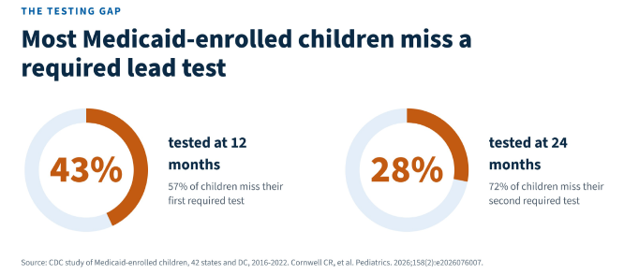
Most of these children have no symptoms, so a blood lead test is the only way to identify exposure. Medicaid requires testing at 12 and 24 months. Yet one CDC study found that only 43% of Medicaid-enrolled children were tested at 12 months, and just 28% at 24 months.3 One barrier is that testing is often sent to an outside laboratory, which may require families to make a second trip, bring a child back for a venous blood draw, and take additional time off work. For many families, those barriers can mean testing never happens.
Point-of-care testing brings the test, and the answer, into the exam room. Here are three ways it can help.
1. More children get tested
When testing happens during the wellness visit, more children complete recommended or required screening. In four Pennsylvania primary care offices, provider education alone barely moved screening rates. When one site added point-of-care testing, the odds of a child being screened at the 1- and 2-year visits rose more than fourfold and continued to improve month over month.4 The difference wasn’t a new guideline or a reminder. It was removing the extra step between ordering the test and completing it.
Higher screening rates matter most for the children who are hardest to reach. Families with limited transportation, inflexible work schedules, or several young children may be less likely to complete testing at an outside laboratory -- and may also be more likely to face environmental or social risk factors associated with lead exposure. Testing at the point-of-care reaches them without asking them to do more.
2. Answers and action before the family leaves
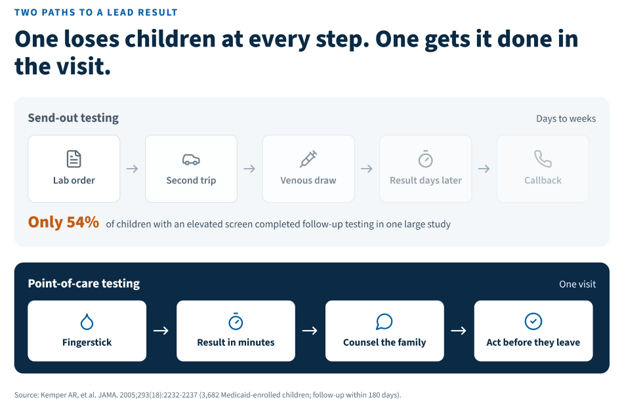
A fingerstick result is ready in minutes. If the result is at or above the CDC’s blood lead reference value, the clinician can explain the result, order a confirmatory venous test, and connect the family with the local health department or other available resources before they leave. That matters: one study found that only 54% of Medicaid-enrolled children with elevated screening results received the recommended follow-up test.5
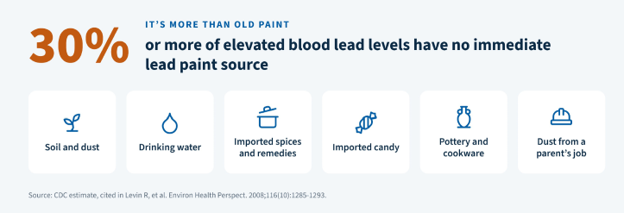
Testing at the point-of-care is also an opportunity to remind families that lead exposure can come from sources beyond old paint. About 30% of children with elevated levels have no immediate lead paint source. 6 Clinicians can ask about other potential sources such as: soil, water, imported spices and candy, pottery, household dust, and lead brought home from a parent’s job. Simple steps to reduce exposure, including handwashing, wet cleaning, and a diet rich in iron and calcium, can start the same day while the source of exposure is being investigated.
If the result is below the reference value, parents receive that information directly from their own clinician, with a chance to ask questions, not through a voicemail days later.
3. Less follow-up work, stronger quality performance
Outside lab orders create a hidden workload: tracking lab slips, matching results that arrive days later and calling families back -- sometimes more than once. When results are available during the visit, those extra steps are reduced, allowing staff to spend more time on patient care.
Lead testing is also connected to quality performance. The HEDIS Lead Screening in Children measure tracks the percentage of children with at least one blood lead test by their second birthday.7 Many health plans tie this measure to quality scores and incentive payments, especially in Medicaid managed care. Testing completed in the office counts toward the measure, giving practices greater control over their performance instead of relying on families to complete testing at an outside laboratory.
Is point-of-care lead testing right for your practice?
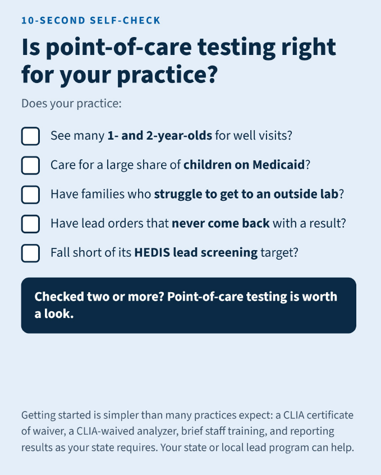
Take 10 seconds. Does your practice:
- ☐ See many 1- and 2-year-olds for well visits?
- ☐ Care for a large share of children enrolled in Medicaid?
- ☐ Serve families who may have difficulty getting to an outside lab?
- ☐ Have lead testing orders that never result in a completed test?
- ☐ Fall short of its HEDIS quality metrics?
Checked two or more? Point-of-care testing is worth a look.
Getting started is simpler than many practices expect: a CLIA certificate of waiver, a CLIA-waived analyzer, brief staff training, and reporting results to your health department as your state requires. Your state or local lead program can help you get set up.
The bottom line
Lead testing protects children when the test gets done and the result leads to immediate action. Point-of-care testing helps make both possible during a single visit. For practices that care for young children, it is one of the simplest ways to close the testing gap and turn a lab slip into an immediate answer. Point-of-care testing can make an immediate difference in a child’s life—helping families identify lead exposure sooner and take steps to reduce further harm.
References
- Council on Environmental Health. Prevention of Childhood Lead Toxicity. Pediatrics. 2016;138(1):e20161493.
- Ruckart PZ, Jones RL, Courtney JG, et al. Update of the Blood Lead Reference Value: United States, 2021. MMWR Morb Mortal Wkly Rep. 2021;70(43):1509-1512.
- Cornwell CR, Pennington AF, Williams T, Ruckart PZ, Courtney JG, Allwood P. Blood lead testing among children enrolled in Medicaid. Pediatrics. 2026;158(2):e2026076007. doi:10.1542/peds.2026-076007. PMCID: PMC13454906.
- Carnahan B, Schaefer EW, Fogel BN. Point-of-care testing improves lead screening rates at 1- and 2-year well visits. J Pediatr. 2021;233:206-211.e2. doi:10.1016/j.jpeds.2021.02.067.
- Kemper AR, Cohn LM, Fant KE, Dombkowski KJ, Hudson SR. Follow-up testing among children with elevated screening blood lead levels. JAMA. 2005;293(18):2232-2237. doi:10.1001/jama.293.18.2232.
- Levin R, Brown MJ, Kashtock ME, et al. Lead exposures in U.S. children, 2008: implications for prevention. Environ Health Perspect. 2008;116(10):1285-1293.
- National Committee for Quality Assurance. Lead Screening in Children (LSC). HEDIS measure. ncqa.org.
- Centers for Disease Control and Prevention. Recommended actions based on blood lead level. cdc.gov/lead-prevention.