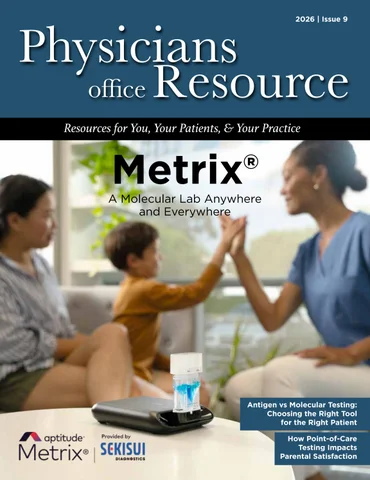
Antigen vs Molecular Testing: Choosing the Right Tool for the Right Patient
Tuesday, September 01, 2026
by Ryan Simeone, SEKISUI Diagnostics
For primary care practices, respiratory season often begins with a familiar problem: overlapping symptoms. Fever, cough, fatigue, myalgia, sore throat, and congestion may reflect influenza or COVID-19; similar signs and symptoms can also occur with other respiratory viruses or noninfectious conditions.5,6 Because symptoms alone rarely identify the cause with certainty, the question is not simply whether to test. It is which test can provide a useful answer for the patient, the clinician, and the workflow of the visit.
Rapid antigen and molecular tests can both support timely outpatient decision-making, but they do so in different ways. Each method detects a different target, carries different implications for sensitivity and interpretation, and fits differently into practice operations. Choosing well requires attention to clinical context, including the patient’s risk, timing of illness, likelihood of infection based on symptoms and exposure, potential consequences of a missed infection, and the need for a same-visit result.
Understanding What Each Method Detects
Antigen tests detect viral proteins. In outpatient respiratory testing, many rapid antigen assays use lateral-flow immunoassay technology to identify viral antigens from respiratory specimens.7,8 Because the target is not amplified, the specimen must contain enough viral antigen for the assay to detect it.7
That feature explains much of antigen testing’s value and its limitations. Antigen assays can be fast, accessible, and relatively simple to perform, making them useful when the result is needed during the office visit.7 However, a negative antigen result does not always exclude infection, particularly when symptoms, exposure history, or local disease activity suggest that infection remains clinically likely.7,9,10
Molecular tests detect viral nucleic acid. These include polymerase chain reaction and other nucleic acid amplification technologies, such as reverse transcription loop-mediated isothermal amplification. Amplifying the genetic target enables molecular methods, including nucleic acid amplification tests (NAATs), to detect viral RNA or nucleic acids with high sensitivity and to be more likely than antigen tests to detect respiratory viruses in respiratory specimens.6,9,11
At the same time, “molecular” should not be understood as synonymous with off-site laboratory testing or delayed turnaround. Compact platforms now allow some molecular
assays to be performed at the point of care. Result time, instrument requirements, throughput, complexity, and cost still vary by system, so operational fit remains part of the decision.
Match the Testing Strategy to the Patient
A practical testing decision begins with three questions.
- How likely is infection based on symptoms, exposure, and current respiratory virus activity?
This assessment reflects symptoms, known exposure, duration of illness, local disease activity, and other epidemiologic information.5,6,7 When infection appears less likely, a negative antigen result may be adequate for many routine outpatient decisions. When infection remains likely, the possibility of infection may remain despite a negative antigen result, and repeat or molecular testing may be appropriate depending on the situation.7,9,10
- What are the consequences of missing the diagnosis?
The answer differs for a healthy young adult with mild illness and an immunocompromised patient or older adult at increased risk of complications.5 If failing to detect infection could delay time-sensitive treatment, expose vulnerable contacts, or materially change the care plan, molecular testing may offer greater clinical value because molecular tests are generally more sensitive than antigen tests for respiratory virus detection.6,9,11
- How quickly must the result be available?
The most analytically sensitive test is not always the most useful if the result arrives after the treatment or follow-up decision must be made. Conversely, the fastest test may not provide enough reassurance when the clinical stakes are high. CDC notes that rapid molecular influenza assays can provide results in approximately 15–30 minutes, while antigen tests typically provide rapid results but are generally less sensitive than NAATs.7,11
Point-of-care coordinators should evaluate total turnaround time rather than assay run time alone. Specimen collection, staff availability, test setup, quality-control requirements, documentation, result reporting, cleaning, and patient communication all influence the actual workflow.
When Antigen Testing Fits the Clinical Need
Antigen testing may be a practical first-line choice for a symptomatic patient who presents during the acute phase of illness, when viral burden is more likely to be detectable. A rapid
result can support same-visit conversations about treatment, infection precautions, work or school attendance, and follow-up.
Speed is especially useful when the result may change the immediate plan. During periods when influenza and COVID-19 circulate at the same time, a combination assay can help distinguish infections that may look similar at presentation.5,6
The OSOM® Flu COVID-19 Combo Test, for example, is a lateral-flow immunochromatographic antigen assay that simultaneously detects and differentiates influenza A, influenza B, and COVID-19 proteins from an anterior nasal swab. The test produces results in 10 minutes and is authorized for point-of-care use in CLIA-Waived settings.1
In general, a positive antigen result can provide useful evidence that the detected virus is present. A negative result, however, should be interpreted in the context of symptom duration, exposure history, local prevalence, and the patient’s risk profile because viral antigen levels may be below the assay’s detection threshold.
For antigen assays, some products may specify that negative results are presumptive and should be confirmed with a molecular assay when necessary for patient management. Negative antigen results should not serve as the sole basis for treatment, infection-control, or other management decisions.1
Antigen testing, therefore, should not be framed as universally inferior. It is a different diagnostic tool whose clinical value depends on timing, patient selection, disease prevalence, and how the result is used.
When Molecular Testing May Be Preferred
Molecular testing may be preferred when greater analytical sensitivity is needed or when the clinical consequences of a false-negative result are substantial.6,9,11
For example, an older adult with cardiopulmonary disease who presents with respiratory symptoms and a known household exposure may need a testing approach that provides more reassurance after a negative result. CDC guidance notes that older adults and people with certain underlying medical conditions are at higher risk for severe influenza or COVID-19 and that testing can help guide treatment decisions when these viruses are suspected.5 In that context, a negative antigen result may be less reassuring than it would be in a lower-risk patient when infection remains clinically likely.7,9,10
Molecular testing may also be appropriate when:
- Symptoms and exposure history strongly suggest infection despite a negative antigen result. 7,9,10
- A more sensitive result is important for a high-risk or immunocompromised patient.5,9,11
- The patient presents at a point in illness when antigen levels may be lower, increasing the chance that a single antigen test could miss infection. 7,10
- The anticipated clinical action justifies the additional time or resources associated with molecular testing, such as antiviral treatment, infection-control decisions, or additional diagnostic evaluation. 5,6,9
- The practice wants an initial molecular answer rather than an antigen-first testing pathway, particularly when test sensitivity is a key priority for patient management. 6,7,9
The Metrix® COVID/Flu Test provides an example of point-of-care molecular testing. It uses reverse transcription loop-mediated isothermal amplification to detect and differentiate COVID-19, influenza A, and influenza B nucleic acid from an anterior nasal specimen.2 The system provides results in 20 minutes, requires no maintenance or calibration, and can be used in a CLIA-waived setting.4
Molecular testing can reduce some forms of diagnostic uncertainty, but it does not eliminate the need for clinical judgment. No respiratory test result should be interpreted apart from the patient in front of the clinician.
Build a Testing Pathway
Practices do not need to select one methodology for every patient. A tiered pathway can use both technologies according to clinical need and operational capacity.
One approach is to use a multiplex antigen assay for eligible symptomatic patients when an immediate result is the priority. Positive findings can then be interpreted with the patient’s history and presentation. If the antigen result is negative but suspicion remains high, the practice can escalate to point-of-care molecular testing or send a specimen for laboratory-based testing, depending on available resources.
Another approach is to begin with molecular testing for high-risk patients, patients whose treatment decisions require a more sensitive initial result, or situations in which follow-up would be difficult.
Protocols should specify:
- Patient eligibility and authorized specimen types
- Appropriate timing relative to symptom onset
- Circumstances requiring serial or confirmatory testing
- Escalation criteria after a negative antigen result
- Documentation and result-reporting responsibilities
- Quality-control procedures
- Staff competency and retraining requirements
- Steps for invalid or inconclusive results
Every test should be performed and interpreted according to its current authorization, labeling, and instructions for use. Practices should also make sure staff understand when to repeat testing, when to confirm a result, and when to escalate care based on patient risk and clinical judgment.
The Right Test Is a Clinical and Operational Decision
The antigen-versus-molecular decision should not be reduced to speed versus accuracy. A better question is whether the test’s performance, turnaround time, workflow, and intended use align with the needs of the patient in front of the clinician.
Antigen testing can provide an accessible, rapid answer that supports same-visit care. Molecular testing can provide greater sensitivity when diagnostic certainty carries additional importance. Multiplex formats in both categories can help distinguish COVID-19 from influenza A and B without relying on symptoms alone.
For primary care physicians, the strongest strategy is often a flexible one. Rapid antigen testing can be used when its speed and the clinical context make the result actionable. Molecular testing may be appropriate when patient risk, likelihood of infection, timing, or the consequences of a missed infection warrant a more sensitive approach.
For point-of-care coordinators, the task is to translate that strategy into reliable daily practice. Clear protocols, staff training, and thoughtful escalation criteria can help ensure that both antigen and molecular technologies contribute to timely, informed respiratory care without overstating what any single test can determine.
References
- SEKISUI Diagnostics. OSOM® Flu COVID-19 Combo Test Instructions for Use. Accessed August 20, 2026. https://sekisuidiagnostics.com/wp-content/uploads/2024/03/3523-0_OSOMComboIFU_29FEB2024-3.pdf
- SEKISUI Diagnostics. Metrix® COVID/Flu Test Instructions for Use. Accessed August 20, 2026. https://sekisuidiagnostics.com/wp-content/uploads/2025/03/IFU-Metrix-COVID-Flu-Final.pdf
- SEKISUI Diagnostics. OSOM® Flu COVID-19 Combo Test. Accessed August 20, 2026. https://sekisuidiagnostics.com/product/osom-flu-sars-cov-2-combo-test/
- SEKISUI Diagnostics. The Metrix® COVID/Flu Test. Accessed August 20, 2026. https://sekisuidiagnostics.com/product/the-metrix-covid-flu-test/
- Centers for Disease Control and Prevention. Clinical Guidance for Outpatients With Acute Respiratory Illness at Higher Risk of Severe COVID-19 and/or Influenza. Accessed September 1, 2026. https://www.cdc.gov/flu/hcp/clinical-guidance/testing-guidance-for-outpatient.html
- Centers for Disease Control and Prevention. Multiplex Tests to Detect Influenza, COVID-19, and RSV. Accessed September 1, 2026. https://www.cdc.gov/flu/hcp/testing-methods/flu-covid19-detection.html
- Centers for Disease Control and Prevention. Considerations for Antigen Testing for Healthcare Providers Testing Individuals in the Community. Accessed September 1, 2026. https://archive.cdc.gov/www_cdc_gov/coronavirus/2019-ncov/lab/resources/antigen-tests-guidelines.html
- Infectious Diseases Society of America. IDSA Guidelines on the Diagnosis of COVID-19: Antigen Testing. Published December 20, 2022. Accessed September 1, 2026. https://www.idsociety.org/practice-guideline/covid-19-guideline-antigen-testing/
- Centers for Disease Control and Prevention. Overview of Influenza Testing Methods. Accessed September 1, 2026. https://www.cdc.gov/flu/hcp/testing-methods/index.html
- S. Food and Drug Administration. Understanding At-Home OTC COVID-19 Antigen Diagnostic Test Results. Accessed September 1, 2026. https://www.fda.gov/medical-devices/coronavirus-covid-19-and-medical-devices/understanding-home-otc-covid-19-antigen-diagnostic-test-results
- Centers for Disease Control and Prevention. Information on Rapid Molecular Assays, RT-PCR, and Other Molecular Assays for Diagnosis of Influenza Virus Infection. Accessed September 1, 2026. https://www.cdc.gov/flu/hcp/testing-methods/molecular-assays.html